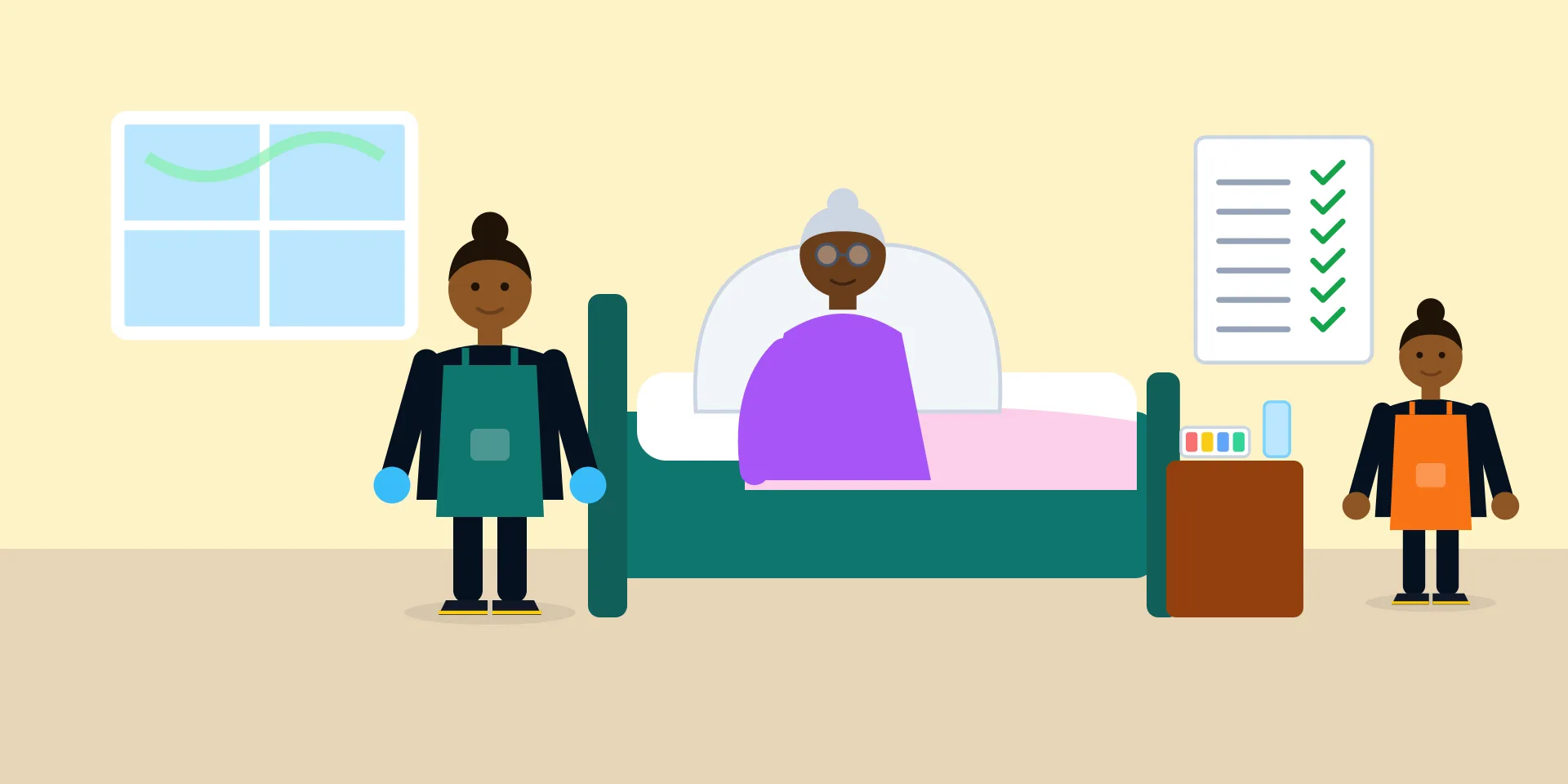
Care for sick, frail and elderly people in their own homes with skill, dignity and compassion. This programme follows the registered QCTO curriculum for the Occupational Certificate: Home Based Personal Care Assistant (SAQA 104779, NQF Level 2, 68 credits) in three parts: knowledge, practical skills and real work experience.
Programme structure
Start with Module 0: Orientation and Your QCTO Programme, free.
Part 1
The fundamentals of home based care: health, wellness, ethics and rights, spirituality and culture, the primary health care team, communication, the social determinants of health and patient-centred care.
Everything included
Start learning today, no card, no commitment.
Every lesson is presented by a GoalVow digital human.
Follows the registered QCTO curriculum 532904-001-00-01 (SAQA 104779).
Course outcomes
Explain health, wellness, ethics, patients' rights and the scope of work of a home based care assistant, and practise self-care
Apply culturally and spiritually sensitive, patient-centred care that improves a patient's quality of life
Use empathetic communication and work effectively within the primary health care and social development team
Identify and report the changing needs of patients and households, including the social determinants of health and the referrals they need
Apply universal precautions and the delegated physical care in a care plan, from daily living and positioning to vital signs and medication support
Demonstrate emotional support, end-of-life comfort, care for people with mental health problems and the right response to emergencies
Plan and run coaching sessions that build patients' and families' practical care skills and treatment adherence
Complete physical care, education, coaching and referrals for patients in a real home based care service, and compile a Portfolio of Evidence for the EISA
Registered qualification
1. Provide holistic care and support to patients and household members.
Certification pathway
Knowledge modules, then the Part 1 written and VR final tests at 80%.
Practical skills, observed against checklists, then the Part 2 written and VR final tests.
Who it's for
Caregivers and community care workers who already care for patients and want their skills recognised
School leavers and job seekers who want a caring career with real demand
Family members caring for a sick, frail or disabled relative at home
Home-based care organisations, hospices and NGOs training their care workers to one standard
Career outlook
Where it leads
You are here
Home Based Personal Care Assistant
NQF 2 · 68 credits
Complete the full qualification
Home Based Carer (NQF Level 3)
Add the other part-qualifications
Move up a level
Health Promotion Officer (Community Health Worker) (NQF Level 3)
The next NQF step
Move up a level
Home Based Carer (NQF Level 3)
The next NQF step
Related part-qualifications that share modules with this one
Enrol free, finish Modules 0–1, and unlock the rest only when you are ready. Earn a verifiable certificate and 1,500 VOWR on completion.
Part 1 Final Test
Written · 80% VR final · 80%
Part 2
Observing and reporting needs, working in the care team, universal precautions, physical care and emotional support, and coaching patients and families in basic care skills, practised in a simulated home.
Part 2 Final Test
Written · 80% VR final · 80%
Part 3
Caring for ten patients over three months, running education and coaching sessions, and following referral processes in a real home based care service, verified by your supervisor.
Part 3 Final Test
Written · 80% VR final · 80% Signed logbook
Practise every module in a virtual kitchenette, including 3 VR final tests.
Every practical lesson has a safety briefing and a do-it, check-it checklist.
Log your work experience; your supervisor verifies it and signs your statement online.
Printable reading material for every module to keep and revise from.
The evidence you need to qualify for the national external assessment.
Pass all three parts at 80% for a GoalVow certificate anyone can verify.
Rewards for real milestones, usable towards your next course.
Your journey
Modules 0–1 open the moment you enrol.
Presented lessons and reading books, then the Part 1 written and VR final tests.
Practise in VR and with observed checklists, then the Part 2 final tests.
Real work, verified by your supervisor, then the Part 3 final tests and your signed statement.
Earn your GoalVow certificate and VOWR, ready for the QCTO external assessment.
2. Communicate effectively with patients and household members to provide care and support.
3. Operate effectively within a multi-disciplinary team context.
Work experience in a real workplace, verified by your supervisor, then the Part 3 final tests and a signed Statement of Work Experience.
Issued when all three parts are passed, with 1,500 VOWR.
External Integrated Summative Assessment (EISA): theory and practical ability, assessed together.
Issued by the QCTO after you pass the external assessment.
Your Portfolio of Evidence collects all of it as you go.
Recognition of Prior Learning (RPL) is available: if you already care for patients, an accredited provider or approved workplace can assess you against the curriculum's internal assessment criteria and issue a statement of results or certify your work experience record for the modules you can prove.
Employers and contract cleaning companies can book seats for staff and run this programme as a cohort. Skills development counts towards B-BBEE, and learnership funding is managed by the SETAs, so ask about current funding windows.
This programme follows the registered QCTO curriculum for the Occupational Certificate: Home Based Personal Care Assistant (SAQA ID 104779, curriculum 532904-001-00-01, NQF Level 2, 68 credits), part of the Home Based Carer curriculum. The QCTO Occupational Certificate itself is issued by the QCTO after you pass the External Integrated Summative Assessment (EISA), arranged through the Health and Welfare SETA (HWSETA). GoalVow gives you the training, the evidence you need to qualify for that assessment, and a GoalVow certificate once you pass all three parts here.
No. A home based care assistant gives basic physical and emotional care under the direct supervision of a professional supervisor, such as a professional nurse or a social worker, and only does what the care plan delegates. The programme teaches you exactly where that scope ends and when to refer. It's a recognised first step if you later want to study nursing.
Part 1 is knowledge (8 credits): health, ethics, rights, culture, the care team, communication and the social determinants of health. Part 2 is practical skills (30 credits): observing and reporting needs, infection control, daily living care, positioning and transfers, vital signs, medication support, emotional and end-of-life care, emergencies, and coaching families. Part 3 is work experience (30 credits): caring for ten patients over three months, education and coaching sessions, and referrals, in a real home based care service. Each part ends with a final test and a VR final test, and you must pass all three parts to earn your certificate.
The SAQA record says home based care assistants work under the direct supervision of a professional supervisor. GoalVow asks for a registered professional nurse or social worker at an organisation that delivers home based care, and who can let you care for at least ten patients over three months. Your supervisor receives a secure link from GoalVow to verify each logbook entry and sign your Statement of Work Experience.
SAQA lists this part-qualification as re-registered until 30 December 2025, with a last date for enrolment of 30 December 2026 and a last date for achievement of 30 December 2029. The QCTO often extends or replaces qualifications, so check the current dates on the SAQA website before you enrol, and plan to finish well before the last date for achievement.
Yes. Home-based care organisations, hospices, NGOs and employers can book seats for their care workers, and the training can count towards skills development. Funding for learnerships and skills programmes is managed by the SETAs, so ask the HWSETA or your organisation about current funding windows.
Yes. Enrol free and work through Modules 0 to 1 with no card needed. You only pay if you want to finish the full course.
A once-off R 299 unlock opens every remaining module, the VR practices, the workplace logbook, the three Part Final Tests and your verifiable GoalVow certificate. Bundle and VOWR discounts are shown at checkout.
The curriculum sets about 680 notional hours (68 credits), including at least 13 weeks of work experience in a real workplace. Most learners finish in about 24 weeks.
No. VR Practice runs in desktop 3D in your browser with a mouse and keyboard. A compatible WebXR headset is optional for the immersive mode.
Your GoalVow certificate has a unique ID that employers can check on our Verify a certificate page. It confirms you passed all three parts of a programme built on the registered QCTO curriculum (SAQA 104779, NQF Level 2). The national QCTO Occupational Certificate is issued by the QCTO after you pass the External Integrated Summative Assessment (EISA).
Yes. GoalVow is built mobile-first, and your progress is saved to your account so you can switch between phone and computer.